
![[seurat] logo source_2024_white_rgb.png](https://static.wixstatic.com/media/ad9b21_332608b3ffb64048b6e881cf0c63341c~mv2.png/v1/fill/w_245,h_40,al_c,q_85,usm_0.66_1.00_0.01,enc_avif,quality_auto/%5Bseurat%5D%20logo%20source_2024_white_rgb.png)

Reshoring
Metal Parts Manufacturing
Area Printing makes the economics work.
The best way to de-risk your supply chain is to reshore critical components
For decades, the logic was simple: put production wherever costs are lowest. On paper it looked efficient, but it left the global industrial base brittle, dependent on supply chains too long to trust and too fragile to surge.
Now that model is breaking down, and the vulnerabilities are no longer theoretical. They show up in delayed programs, constrained capacity, and the uncomfortable realization that too much of what the world relies on is made in places where customers have less visibility, less leverage, and fewer options when conditions change.
Seurat was built for a different model, one grounded in local factories, domestic talent, and production capacity closer to the communities and economies it serves.


The problem with “offshore is cheaper”
The unit cost calculation that drove three decades of offshoring never accounted for the full picture. Left out of the math: lead time risk, logistics exposure, currency volatility, tariff changes, geopolitical disruption, and the compounding cost of innovation delayed because production is too far away to iterate quickly.
When a supply chain breaks, the damage doesn’t show up as a line item. It shows up as a stalled program, a delayed product launch, a contract that goes to a competitor who can actually deliver.
The manufacturers winning now understood earlier than most that resilience and competitiveness are not opposing forces but the same thing. Bringing production closer to demand is one of the most effective ways to de-risk a supply chain and lower long-term cost.
How Area Printing® makes reshoring practical
Reshoring stalls at the business case, not for lack of will. The spreadsheet hasn’t been updated: traditional cost models assume part-specific tooling amortized over long production runs, minimum order quantities set by that tooling, and stable demand across the amortization period. Area Printing changes those inputs.
Area Printing requires no part-specific tooling, so there is no tooling cost to amortize and no minimum order quantity set by tooling economics. Production volume flexes with demand. Domestic production then competes on more than unit price alone, especially where lead time, inventory, qualification, responsiveness, and supply-chain risk matter.
De-risking your supply chain used to mean accepting tradeoffs. With Area Printing, it means gaining capability.
The technology that makes reshoring practical for more applications has finally arrived.

Industrial resilience depends on where parts are made
Industrial capacity concentrated in politically unstable or adversarial regions creates exposure that no tariff or trade policy can fully offset. The ability to produce critical components close to where they are needed, and to surge that production when conditions demand, is foundational to economic resilience and national security alike.
That applies to defense-critical hardware, where the stakes are most visible. But energy, advanced manufacturing, semiconductor equipment, and any sector where production continuity is non-negotiable faces the same exposure.
Every factory Seurat builds creates skilled manufacturing jobs, develops regional talent, and adds productive capacity to the economies it operates in. That is not a secondary benefit; it is a core part of what makes the model worth building.
Local production shortens development cycles
Bringing manufacturing closer to home doesn’t just de-risk supply chains. It compresses the distance between design and production, which accelerates innovation. Engineers who can iterate quickly, validate at volume, and respond to customer feedback in real time build better products than engineers constrained by offshore lead times and minimum order quantities.
The companies investing in local production capacity now are building a structural advantage over competitors still dependent on systems that cannot flex, cannot surge, and cannot keep pace with the speed the market demands.
It starts with a decision: stop waiting for the world to stabilize and build for the world as it actually is.
Production close to home. Supply chains you can count on.
Scale Your Possible.
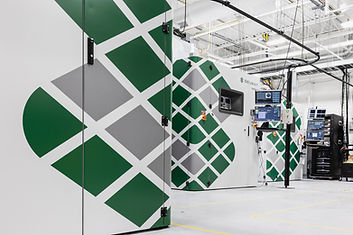
No. Area Printing requires no part-specific tooling, which removes both tooling cost and tooling lead time from a reshoring business case.
Frequently Asked Questions
Does Area Printing require part-specific tooling?
Does Seurat produce prototypes or one-off parts?
No. Seurat is a production supplier rather than a prototyping service, and prints parts at production volume using Area Printing, which requires no part-specific tooling.
What is the minimum order quantity for reshored parts?
There is no single minimum order quantity across all parts, because the practical minimum depends on part geometry. Size and shape determine how many units fit in each build, and that per-build yield sets the economics for a given part. Submit a part file and a target annual volume and Seurat will assess the quantity threshold for that specific geometry.
Which manufacturing processes can Area Printing replace?
Area Printing can replace machining, casting, and forging, particularly where tooling cost or offshore lead time drove the original sourcing decision.

![[seurat]-05.05.23-CINCO-DE-MAYO-TEAM.JPG](https://static.wixstatic.com/media/953c5a_55edb7cf9a8646f882299ae8e5202419~mv2.jpg/v1/fill/w_301,h_184,al_c,q_80,usm_0.66_1.00_0.01,enc_avif,quality_auto/953c5a_55edb7cf9a8646f882299ae8e5202419~mv2.jpg)

Stay connected with us
The personal data you have voluntarily supplied is collected, stored and processed in adherence with Seurat Technologies’ Privacy Policy which has been recognized by the European Data Protection Authority as providing adequate protection to personal data.
Seurat Technologies does not sell your personal data to third parties.